










What Three Long-Standing Clients Actually Told Us About Freight

An inspection hold in Australia, a delivery week in Amazon Seller Central, and a client who stopped importing — and what we changed because of them.
Global Vertical · Voice of the Customer · 9 November 2026 · 8 min read
We sent a short card to a handful of long-standing accounts with three options: A. response speed, B. professionalism, C. value for money. We expected ticks in boxes.
What came back was better, and considerably less flattering.
An Australian client asked for his bill of lading and container number so he could phone customs himself. A US client told us our updates were fast but not precise enough to paste into Amazon. A third gave us top marks, then quietly stopped shipping altogether.
None of these is a testimonial in the usual sense. One told us our timing had not been good enough. One told us our format was wrong. One had no complaint at all, and no more cargo either.
We are publishing all three, including the sentences we would normally be tempted to trim. This is a voice-of-the-customer note, not a case-study reel. The weight here sits on what hurts, then on what we changed, and only briefly on who we are.
1. "Australian customs doesn't hold items for that long."
Micheal · Australia · inflatable boats and electric pumps · ships almost monthly
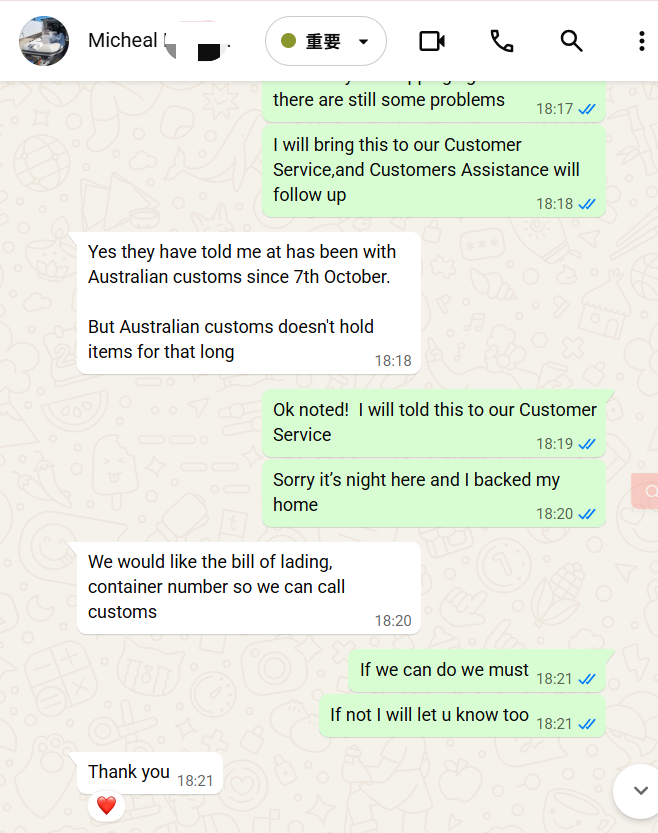
Figure 1. Micheal asking for the bill of lading and container number so he could call Australian customs himself. (Alt text: WhatsApp exchange in which an Australian importer requests B/L and container details during a customs hold.)
Micheal moves inflatable boats and electric pumps into Australia nearly every month. His business runs on tight replenishment cycles, so transit reliability is not a preference for him — it is the product. When a consignment sat with Australian customs from 7 October with no movement, he did not ask for reassurance. He asked for documents.
"Yes they have told me it has been with Australian customs since 7th October. But Australian customs doesn't hold items for that long."
"We would like the bill of lading, container number so we can call customs."
Read that carefully. He was not primarily angry about the delay. He was pushing back on an explanation that had stopped being information. "It's with customs" is the most convenient sentence in this industry: true, uncheckable, and endlessly repeatable. After a certain number of days it stops answering the question and starts closing the conversation.
For a monthly shipper, the real cost of an information vacuum is not the demurrage line. It is that he cannot decide anything — whether to air-freight a replacement, whether to push out a customer install, whether to reorder. A vague update removes his ability to act. A precise "nothing has changed" at least gives him back the decision.
The line we nearly left out
A follow-up conversation a few weeks later was less comfortable.
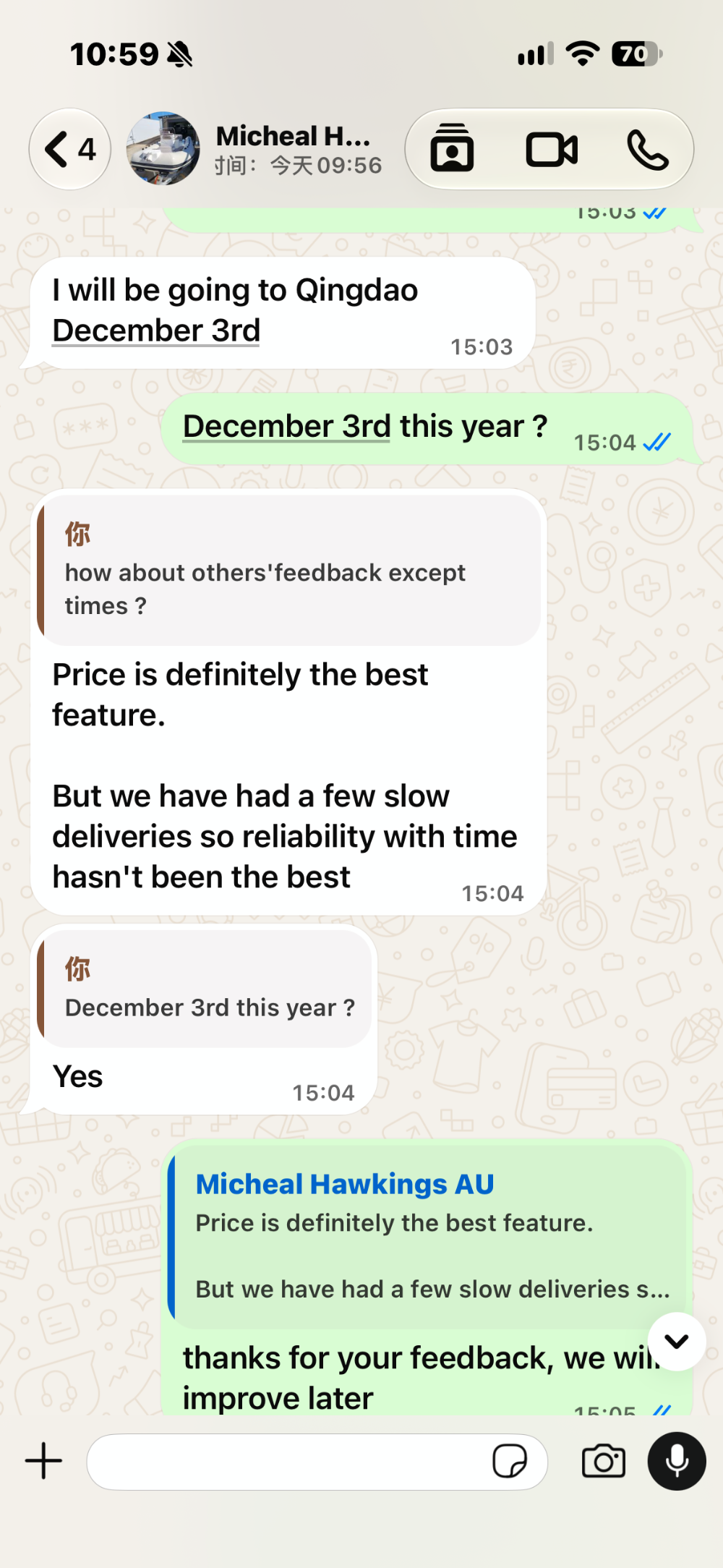
Figure 2. Micheal's unprompted feedback on price versus transit reliability. (Alt text: Client feedback stating price is the strongest feature while delivery reliability has fallen short.)
"Price is definitely the best feature. But we have had a few slow deliveries so reliability with time hasn't been the best."
We left that second sentence in.
It would be easy to publish the first half as a quote and stop. We won't. A client who says our rate is the best thing about us, and our timing is not, has told us exactly where the work is. Deleting the second half would turn feedback into advertising, which is the precise thing this article is trying not to be.
Two messages later he was telling us he would be in Qingdao on 3 December. The relationship had not been damaged by the honest answer. If anything, the ticket stayed open.
What we did that night
We did not have a neat answer. The file was still with customs, waiting on their next action, and we had no clearance date to offer — so we did not invent one. We did not use "customs inspection" as a way to end the thread. We confirmed we would pass the request to our customer service team, made the B/L and container number available, and committed to a rule rather than a date:
If there is an update, you get it first. If there is no update, you get that too.
He replied "Thank you." with a heart.
That is the whole outcome. Not a resolved shipment, not a recovered ETA — a client who stopped having to chase us. In cross-border freight, breakdowns are routine. The service differentiator is whether the person on the other end is told the truth while the breakdown is still happening. Transparency does not move a container. It does something harder: it lets the client keep running his business.
2. "Give us the delivery week, not a general timeframe."
Cheryl · United States · fitness equipment and furniture · monthly into multiple Amazon FBA warehouses
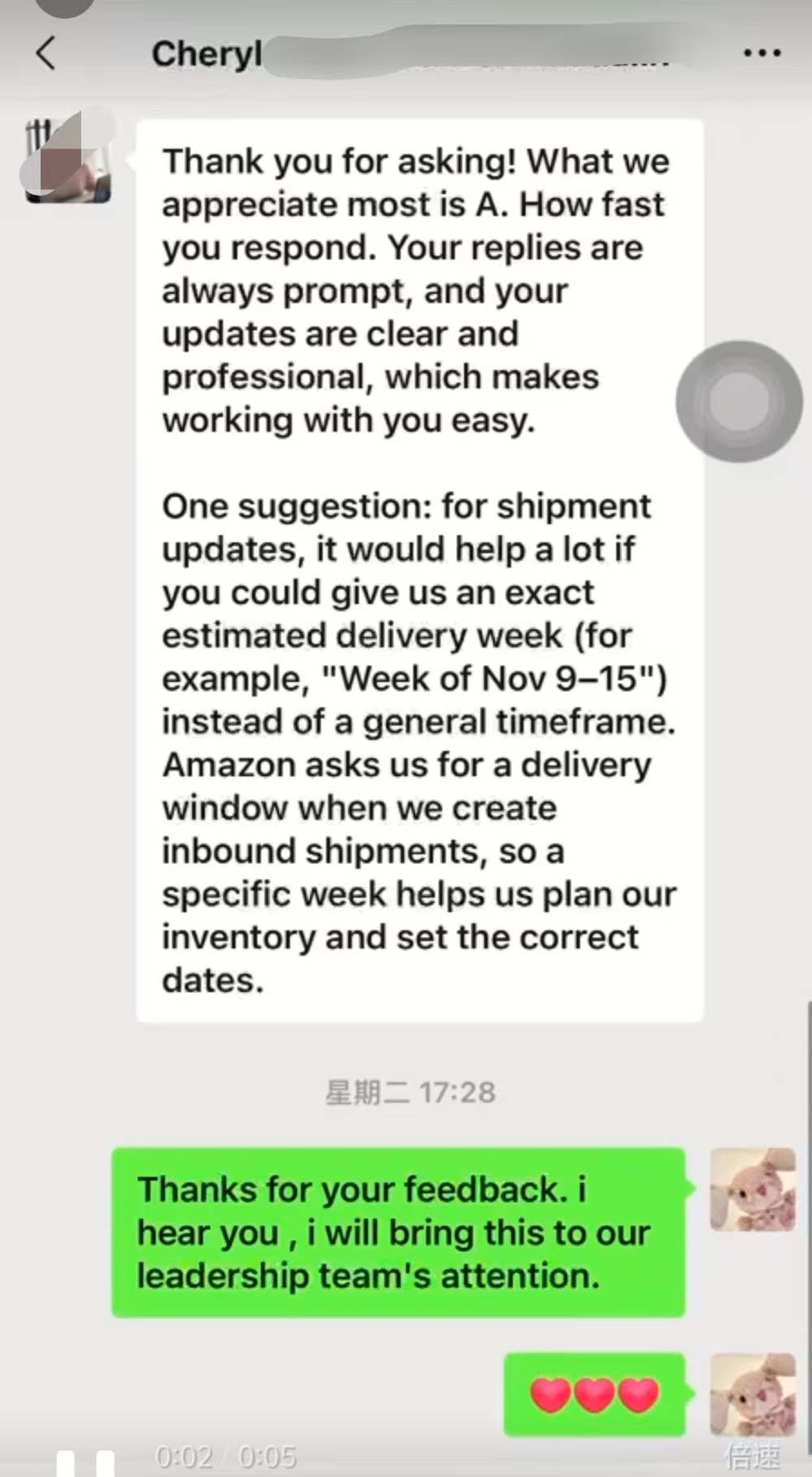
Figure 3. Cheryl's feedback: fast, clear updates — plus one specific request on ETA format. (Alt text: Client message requesting an exact estimated delivery week for Amazon inbound shipment planning.)
Cheryl picked A. response speed without hesitating:
"Your replies are always prompt, and your updates are clear and professional, which makes working with you easy."
Then she gave us something worth more than the compliment:
"One suggestion: for shipment updates, it would help a lot if you could give us an exact estimated delivery week — for example, 'Delivery Week Nov 9–15' — instead of a general timeframe. Amazon asks for a very specific week when we create inbound shipments, so a specific week helps us plan our inventory and set the correct dates."
This is the most operationally literate feedback we received all quarter, and it exposes a gap most forwarders do not know they have.
Why "around mid-November" is not an ETA
To a logistics team, "mid-November" is a reasonable, honest answer. It communicates a range and avoids over-promising. To an Amazon seller, it is unusable.
When a shipment is created in Seller Central, the platform asks for a Delivery Window. That field drives inventory planning, restock limits, FC appointment expectations and, ultimately, whether a listing stays in stock. A broad window cannot be entered. So the importer does one of two things: guesses, or waits. Both are expensive.
The pain here is not speed of reply. We were already replying fast. It is granularity mismatch — our update was written for a freight conversation, while her workflow needed a value she could paste into a form. For FBA sellers, hitting the node matters as much as moving the box. Freight is not "getting it there"; it is getting it there inside a field the system will accept.
What changed
We have upgraded our ETA reporting standard for every FBA account.
|
Before |
After |
|---|---|
|
"Around mid-November" |
"Delivery week: 9–15 Nov" |
|
A broad range the client re-interprets |
A value ready to paste into the Amazon Delivery Window |
|
An update when something happens |
A fixed update cadence, including "no change" |
|
ETA as a courtesy |
ETA as an input to inventory planning |
One deliberate boundary: we upgraded from a vague range to a week, not to a guaranteed calendar date. A delivery week is specific enough to plan against and honest enough to stand behind. It sits alongside the checkpoints we can actually evidence — sailing cut-off, ISF 10+2 filing, SI and VGM, port release, drayage and FC appointment — rather than floating above them as a promise.
Cheryl asked for a format. She changed how we report to every FBA client on the board.
3. "All answers are AA's." — from a client who no longer ships
Alex · Brisbane, Australia · formerly auto parts · now vehicle rental

Figure 4. Alex's full-marks feedback, sent after he had moved into a different business. (Alt text: Client rating all service options top marks and naming professionalism as the strongest.)
We thought this would be the throwaway reply. Alex had moved out of auto parts importing — from 2023 through July 2026 he was a regular, and now he runs a vehicle rental business. No active lane, no open quote, nothing for us to win. We asked anyway, mostly because the conversation had started with Brisbane and an invitation to come visit.
"All answers are AA's. A good blend with the services and pricing. Professionalism is the top."
That landed oddly. Pleased, and quietly disappointing at the same time.
He is the third kind of customer pain, and the one nobody puts in a deck: churn that has nothing to do with you. In B2B logistics we are trained to read silence as a service failure — a late update, a rate that drifted, a competitor's call. Sometimes the client simply changed lanes. The cargo stops, the relationship does not, and there is no corrective action to take.
It is tempting to treat every dormant account as a recovery target. We are not going to do that with Alex. There is no follow-up sequence here, no "we'd love to have you back" pitch. The honest reading is: the work ended well, the door stays open, and he has a business to run. If he ever needs a lane again, we are where he left us.
Not every customer story needs a conversion at the end of it. Some are just a record that the work was done properly.
What changed across the account base
Three conversations, three changes. None of them is a slogan; each is something a buyer can ask us for and check.
1. A transparency protocol for exceptions.
A named owner on any held shipment, a fixed status cadence, and an explicit "no change" update when there is nothing to report. B/L, container number and the current document set are available on request rather than after escalation. We do not close a ticket with "it's with customs" and go quiet. If we cannot fix it yet, we say that.
2. A delivery-week ETA standard for FBA.
Every Amazon-bound shipment gets an exact delivery week in a paste-ready format, backed by a pre-lodgement checklist: cut-off, ISF 10+2, SI, VGM, port release and delivery appointment. Built for the Delivery Window field, not for a status email.
3. Loading evidence, not loading claims.
Clean empty-container inspection before stuffing, a written pack spec signed off ahead of pickup, a layer-by-layer photo log issued the same day, and seal number / VGM / clearance docs prepared before cut-off. This is what "professionalism" looks like when a client asks to see it.
Call these checkpoints, not guarantees. We would rather publish the steps we can evidence than a date we cannot stand behind — a habit that started with a client asking how we make transit time reliable, and was reinforced by a client telling us we had been slow.
For buyers comparing partners: send us cargo type + CBM + destination postcode (AU) or ZIP / FC code (US) + your target delivery week. We will return a working schedule — loading date, cut-off, document checkpoints and a delivery week — not a generic rate sheet.
Micheal wanted the truth. Cheryl wanted a week. Alex wanted nothing at all, and still said the professionalism was top. We can work with all three.
About Global Vertical
Global Vertical is a one-stop import and export supply-chain platform serving worldwide markets. Our teams cover procurement, inspection, warehousing and transportation, with dedicated capability in Amazon FBA, FCL and LCL ocean freight, air and land, China–Europe rail, dual customs clearance and DDP/DDU lanes into Australia, North America and Europe.
Fifteen years in, we have worked with 2,000+ overseas clients, moved 600+ categories of goods, and shipped into 200+ countries and regions. The scale is useful mainly because it gives us pattern recognition: the same three problems in this article show up in different ports, under different names, every week.
Talk to us
Echo Zhou · services@global-vertical.com · WhatsApp +86 159 7311 4531