










Professional, Fast, and Visible: What Two Long-Term Clients Told Us About Choosing a China Supply Chain Partner

Professional, Fast, and Visible: What Two Long-Term Clients Told Us About Choosing a China Supply Chain Partner
Every freight company says it is professional and fast. Very few can prove it. So we stopped making the claim, picked up the phone, and asked two clients what they actually value.
- Why we called clients with nothing to sell
- Sundar (Canada): why a restaurant owner chose "professionalism"
- Brook (Australia): why "all three" still wasn't enough
- What professionalism, speed and visibility really mean in practice
- How we work, and how to reach us
"Professional" and "fast response" are the two phrases you will find on almost every logistics website. They are also the two phrases buyers trust least, because everyone says them and nobody defines them.
So we decided to do something slightly uncomfortable. Instead of writing another claim about ourselves, we contacted two long-term clients and asked them a direct question: as our partner in China, what do you value most about working with us?
We were not calling to pitch new business. We said that explicitly. And the two answers we received — one from a restaurant owner in Canada, one from an electronics seller in Australia — turned out to describe far more accurately what importers are really looking for than any slogan we could have written ourselves.

Case 1 — Sundar, Canada: "Professionalism," chosen without hesitation
Industry: Food & beverage · Shipment: Kitchenware · Terms: DDP
Sundar runs a food and beverage business in Canada. The last time we worked together, we moved a shipment of kitchenware for him on a DDP (Delivered Duty Paid) basis.
Because of the twelve-hour time difference and the rhythm of his purchasing, we rarely reach out to him. We are not in the habit of interrupting clients just to stay visible. So when we did contact him this time, we opened with a clear disclaimer:
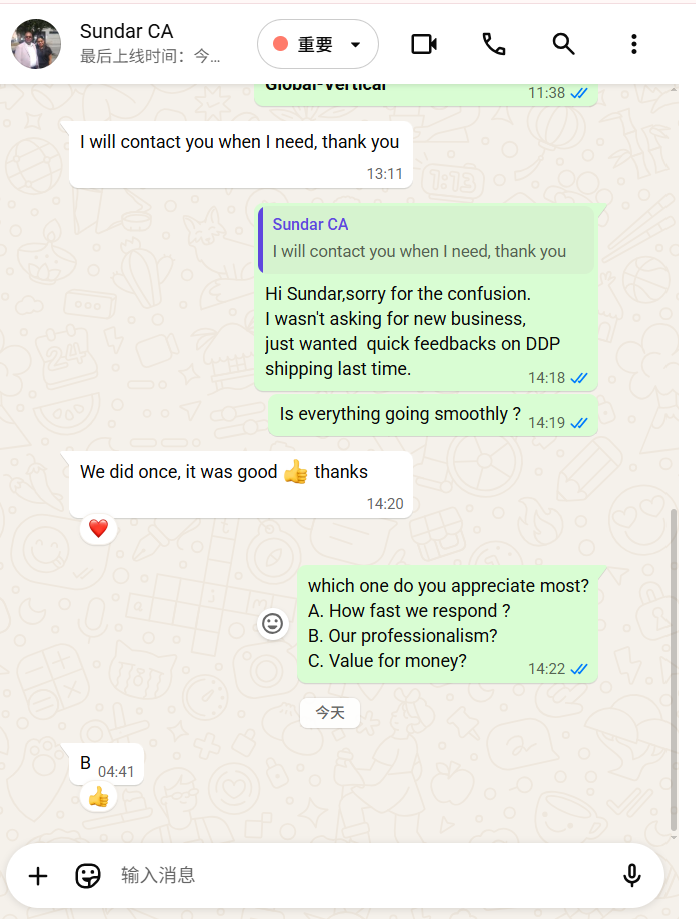
"This is not a sales call. We just want to hear how the last DDP shipment actually went."
His reply was short and unhurried: "Last cooperation was good, thank you."
Then we asked the question. Given three options — response speed, professionalism, and cost performance — he chose:
B. Professionalism
No hesitation. No weighing of trade-offs. That answer is more meaningful than it first appears.
Professionalism is the ability to absorb complexity
For most small and medium buyers running a restaurant, a retail store or a physical operation, the logistics chain is not something they want to understand. They did not go into business to learn HS codes, duty calculation, customs clearance windows or last-mile scheduling. They went into business to serve their own customers.
What they actually need is a worry-free partner: someone who can pay the supplier on their behalf, handle customs clearance correctly, deliver the goods safely, and then get out of the way.
For clients like Sundar, professionalism is not a certificate hanging on a wall. It is the experience of not having to think about logistics at all. It is handing over the complicated part and keeping your attention where it belongs — on the menu, the customers, the next order.
That is what a DDP shipment should feel like. One instruction from the client, one partner responsible end to end, one outcome: goods arriving where they are supposed to, without the buyer having to become a freight expert first.
Case 2 — Brook, Australia: "All three," plus the complaint we needed to hear
Industry: Electronics · Channels: Online + offline · Frequency: Monthly
Brook is based in Australia and runs an electronics business across both online and offline channels. His supply chain is genuinely hard to manage: many suppliers, mixed product categories, and shipments going out almost every month.
When we asked him the same question, he did not pick one option. He answered:
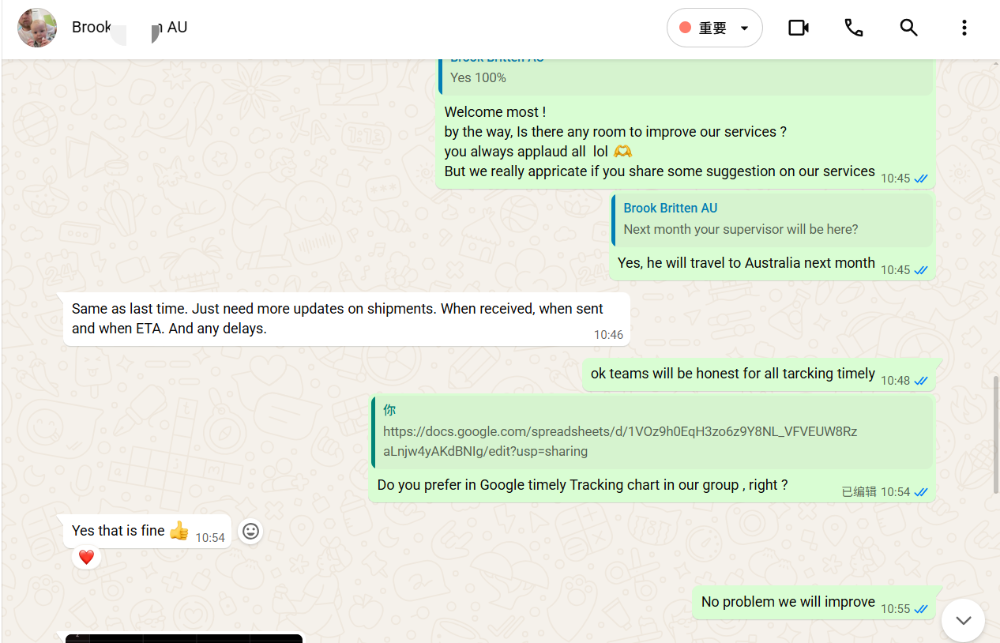
"All 3" — response speed, professionalism, and cost performance. All of them.
And then he told us the part that mattered most.
"I need more updates about my goods. When it's received, when it ships, what the ETA is, and any delays. And because I work with many suppliers, shipments sometimes get split — I need to know exactly what's inside each carton."
He was describing, with unusual precision, the core pain of cargo consolidation.
Why consolidation creates a blind spot
When goods from five different suppliers are combined into one shipment, the buyer loses the one thing they cannot afford to lose: visibility. Which carton holds which product? Did everything actually arrive at the warehouse? If something is missing, whose shipment was it in — and when did it go missing?
Without answers, an e-commerce seller cannot plan. You cannot commit to a listing date, promise a customer a delivery window, or decide whether to reorder, if you do not know what is physically in the container.
We thanked Brook for being blunt, because that is the only way a service actually improves. Polite five-star feedback feels good and changes nothing. Specific feedback is uncomfortable and fixes things.
What we changed for him
- A live Google tracking sheet. Built specifically for his shipment pattern, so status — received, shipped, ETA, delay — is visible at any hour in his own time zone, without sending an email and waiting for a reply.
- Stricter inbound unpacking and carton-level checks. Every carton is recorded and matched before consolidation, so the contents of each box are known and verifiable.
Every carton now has a clear identity. No guessing. No "let me check and get back to you." That is what we mean when we say professional is not only about clearing customs quickly and running stable channels — it is about turning a black box into something a client can see.
What these two answers tell us
Put the two stories side by side and a working definition appears — not of what we claim, but of what clients pay for.
1. Professionalism means reducing twenty steps to one instruction
Sundar never had to learn how DDP works. That was the entire point. A professional partner takes a process with dozens of moving parts — supplier payment, export declaration, freight booking, customs clearance, duty, last mile — and compresses it into a single instruction from the client.
2. Speed means answering before doubt starts to build
Brook ships monthly across many suppliers. At that rhythm, a slow reply is not merely inconvenient; it stops him from planning inventory, listings and cash flow. Fast response is not politeness layered on top of the service — it is part of the service itself. A message answered in hours prevents a decision delayed by days.
3. Visibility means turning the black box into a dashboard
Goods in transit are invisible by nature. Our job is to make them visible: what arrived, what shipped, what is late, and what is inside each carton. If a client has to ask, we have already left it too late.
4. Honest feedback is the real quality control
Both of these answers came from asking, not assuming. We would rather hear "I need more updates" than collect a polite review that quietly hides a problem. The tracking sheet Brook uses today exists because he was willing to say the uncomfortable part out loud.
How this shows up in the way we work
- DDP and DDU dedicated lines — one partner responsible from supplier to door, so the client never has to manage the handoffs.
- Supplier payment and consolidation — we pay multiple factories on your behalf, receive goods into our warehouse, and consolidate them with carton-level records.
- Dual customs clearance — export and import handled under one accountable team, not passed between agents.
- Inspection before shipping — problems found in China, not discovered at destination.
- FCL, LCL, sea, air, land, truck and rail — matched to your volume and deadline instead of pushed toward one channel.
- Amazon FBA handling — labelling, carton marks and delivery requirements taken care of before the truck leaves.
- Proactive status updates — received, shipped, ETA and any delay, pushed to you rather than waiting to be asked.
Frequently asked
Do you handle DDP to Canada and Australia?
Yes. DDP and DDU dedicated lines to Canada, Australia, the US, the UK and Europe are part of our core service, including customs clearance and duty handling on the destination side.
I buy from many suppliers. Can you consolidate and tell me what is in each carton?
Yes. Goods from multiple suppliers are received into our warehouse, checked and recorded at carton level before consolidation. We can also set up a live tracking sheet so you can see status without waiting for an email.
How quickly do you respond to messages?
Our team works across time zones and aims to respond within hours, not days — because for clients shipping monthly, a delayed answer is a delayed decision.
Can you inspect goods before they ship?
Yes. Inspection is available before consolidation and loading, so quantity, specification and packing problems are identified in China rather than at destination.
About Global Vertical
Global Vertical is a one-stop import and export supply chain platform. For 15 years, we have helped clients move goods efficiently with warehousing, transportation sourcing, and inspection — plus Amazon FBA, sea, air, land, truck and rail freight, full container and LCL, dual customs clearance, and DDP/DDU dedicated lines.
So far we have served over 2,000 overseas clients, shipping 600+ product categories to more than 200 countries.
Whether you are a restaurant owner who wants one DDP shipment handled end to end, or an e-commerce seller consolidating from a dozen suppliers, the standard is the same: professional execution, fast response, and a shipment you can actually see.
Let's make your supply chain more simple.
Email: services@global-vertical.com
WhatsApp: +86 159 7311 4531
Get a quoteClient names and shipment details are used with permission. Feedback was collected as part of our ongoing client review programme.


