










Middle East Shipping Routes Suspend Cargo Acceptance as Rising Tensions Disrupt Global Trade
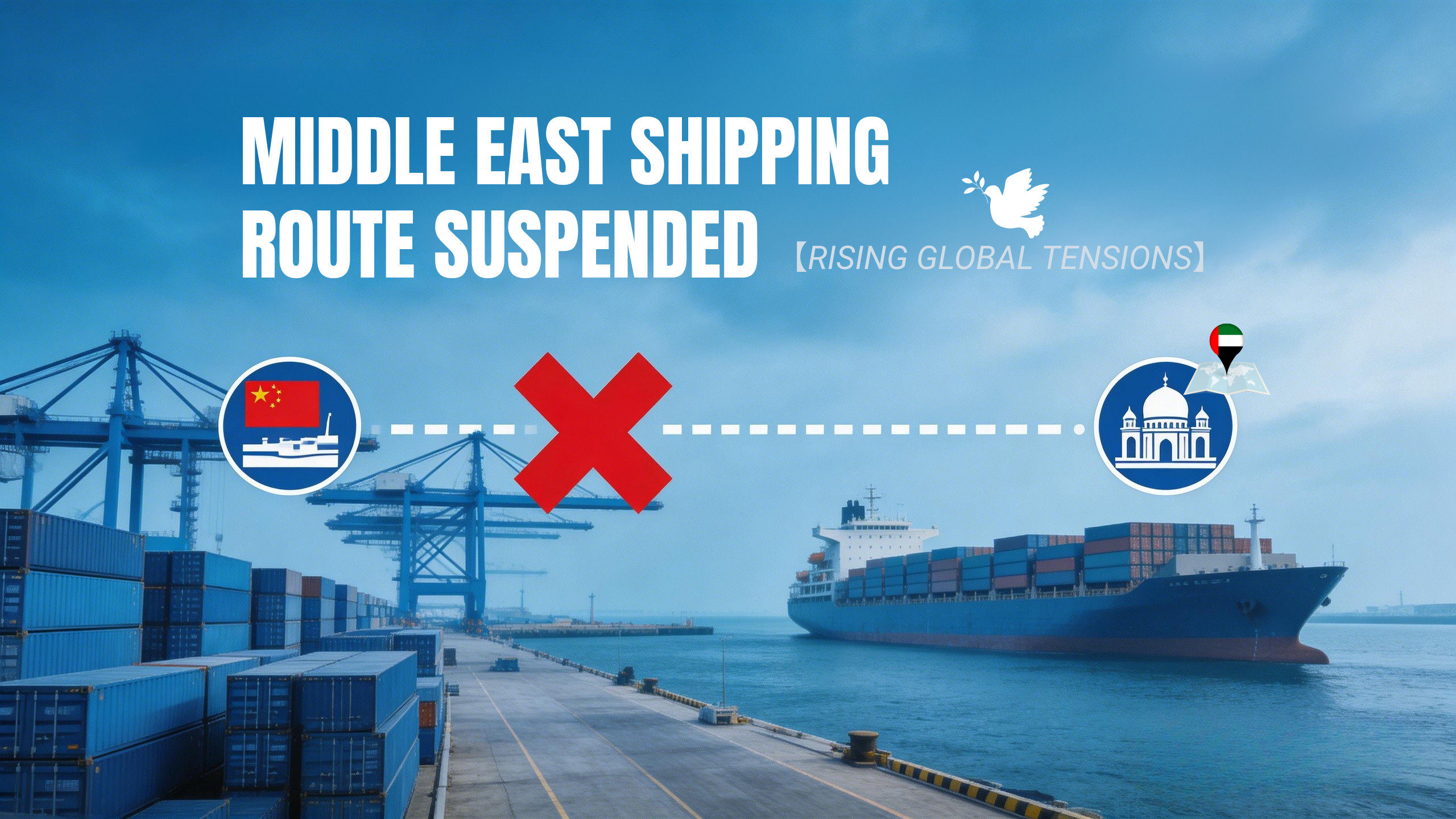
Middle East Tensions Disrupt Shipping Through the Strait of Hormuz
Geopolitical tensions in the Middle East continue to escalate, causing a sharp decline in vessel traffic through the Strait of Hormuz, one of the world’s most critical energy and shipping corridors.
Following a series of attacks on several ports in the region, both dry bulk and container shipping activities across parts of the Middle East have been severely disrupted.
According to several Chinese freight forwarding companies, cargo acceptance for shipments to the Middle East has already been suspended.
On March 2, global logistics giant Kuehne+Nagel stated that the Strait of Hormuz is effectively facing closure, with container vessel traffic dropping to nearly zero. The company said it is working closely with all carriers to identify cargo congestion points and explore solutions to maintain service continuity for customers.
Cargo to the Middle East Suspended, Cross-Border E-commerce Slows
“Some shipping lines are not only avoiding the Persian Gulf route (which requires passing through the Strait of Hormuz), but are also bypassing the Red Sea route leading to the Suez Canal,” said Gao Xuefeng, China General Manager of global ship brokerage firm Mavega Group, on the evening of March 1.
According to Gao, rerouting vessels for safety reasons will significantly extend shipping distances. Combined with rising fuel prices, this will inevitably introduce greater uncertainty to the market.
Zygli Zhu, founder of Global Vertical, noted that the current situation in the Middle East will inevitably impact foreign trade companies. However, the timing somewhat mitigates the immediate impact.
“After the Lunar New Year, it is typically the off-season for shipments. Most Chinese factories have only just resumed operations, and many Middle Eastern buyers are postponing new orders while observing the situation,” Zhu explained.
The suspension of cargo shipments to the Middle East stems from two main factors. On one hand, geopolitical tensions have prompted shipping lines to raise freight rates. On the other hand, cargo volume to the region is relatively low at this time of year, leading carriers to temporarily halt services after weighing multiple considerations.
Freight Rates Surge as Market Faces New Challenges
According to the Shanghai Shipping Exchange, the Shanghai Containerized Freight Index (SCFI) rose 6.5% in the latest report released on February 27.
Freight rates increased across multiple routes, including those to Europe, the United States, the Persian Gulf, Australia–New Zealand, and South America.
Notably, the freight rate from Shanghai to major Persian Gulf ports climbed sharply to $1,327 per TEU, representing a 35.4% increase compared to the previous period.
The rise is largely attributed to escalating geopolitical tensions in the region and the approaching Ramadan, which traditionally affects shipping schedules and market dynamics.
Cross-Border E-commerce Hit Harder by Short-Term Disruptions
Unlike traditional foreign trade, which typically involves longer lead times for ordering, production, and transportation, cross-border e-commerce relies heavily on faster delivery cycles and is therefore more vulnerable to short-term disruptions.
Even before the recent incidents affecting Middle Eastern ports and Amazon Web Services (AWS) infrastructure in the region, Amazon had already begun implementing contingency measures.
On March 1, the company announced the suspension of all operations and delivery services in the United Arab Emirates, further impacting regional logistics and e-commerce activity.
Raw Material Prices Surge Amid Supply Chain Pressure
While many export manufacturers have only recently resumed production after the holiday period, their biggest concern is not shipment delays but the rapid rise in raw material costs.
“Aluminum prices surged yesterday, and plastic prices have also skyrocketed since they are downstream petroleum products,” said a Chinese factory owner focused on the Middle Eastern market.
The factory had stocked some raw materials before the holiday as an emergency reserve, but the supply is expected to last only about two weeks.
“Many metal materials are now almost as valuable as gold,” said the owner of a wall-mounted boiler manufacturing company in Guangdong Province, whose exports to the Middle East account for about 20% of total shipments.
The suspension of shipments is already causing challenges, but the surge in raw material prices has made the situation even more difficult. Existing orders cannot yet be given confirmed delivery dates.
Oil Prices, Metals, and Gold All Climb
As a key artery of global energy supply, disruptions in the Strait of Hormuz not only push oil prices higher but also trigger broader commodity price increases through rising costs, supply shocks, and market risk sentiment.
On March 2, Brent crude oil prices surged nearly 13% intraday, reaching a high of $82.37 per barrel.
Higher oil prices have directly impacted the global petrochemical supply chain.
At the same time, gold prices have continued to rise, while stronger domestic industrial activity in China has boosted demand for base metals.
Prices for copper, aluminum, and zinc have all rebounded, with LME copper and LME aluminum continuing their upward trend. Domestic non-ferrous metal processing and smelting costs have also risen accordingly.
Strategic metals such as tungsten and rare earth elements have seen even sharper price increases due to supply constraints and strong demand from high-end manufacturing industries.
Currency Appreciation Adds Pressure on Exporters
Rising material costs are not the only challenge facing Chinese exporters.
The appreciation of the Chinese yuan has also begun to squeeze profit margins for many small and medium-sized foreign trade companies.
“Last year the exchange rate was around 7.29 yuan per US dollar, and now it has strengthened to about 6.9,” one exporter noted.
With global uncertainties increasing, currency volatility has also intensified.
On March 3, the central parity rate of the yuan strengthened by 148 basis points to 6.9088, marking the highest level since May 4, 2023, and the largest single-day adjustment since August 25, 2025.
According to Wind data, as of 9:37 a.m. that day, the onshore yuan was trading
Our experts provide customized logistics solutions including DDP, door-to-door, and FBA head-haul services.


